

Inflation Reduction Act Resource Hub
As the Medicare Drug Price Negotiation Program (MDPNP) transforms the prescription drug market, HealthHIV champions the essential needs of patients amid the rollout of negotiated prices for high-cost medications and adjustments by healthcare stakeholders.
The Hub aims to:
- Safeguard access to life-saving drugs and ensure Medicare beneficiaries can continue receiving necessary treatments.
- Foster equitable access and affordability through the implementation of negotiated Maximum Fair Prices (MFPs) for selected Medicare drugs.
- Support vital public health initiatives by addressing potential effects of drug pricing changes on patients, providers, and healthcare systems.
- Amplify the patient voice in debates over Medicare drug price negotiations and related policies on medication access, affordability, and treatment choices.
Learn More
The Centers for Medicare and Medicaid Services has announced the selection of a widely used HIV treatment for Medicare price negotiation under IPAY2028 as part of the Inflation Reduction Act.
For our community, this issue is not abstract.
This is a critical time to share your experience.
Here’s What You Need to Know Now:
2028 IPAY Medicare Drug Price Negotiation Program public engagement process: CMS is negotiating prices for 15 drugs and is inviting patients, advocates, and providers to share real-world experience with these medications. Input from people affected by HIV—and those who care for them—can directly inform these negotiations.
The links below provide practical tools to help you prepare, understand, and make the most of these opportunities.
- When Cost-Cutting Undermines HIV Care—The Case for Single-Tablet Regimens
Op-Ed in PositivelyAware, April 21, 2026 - National Health Council IPAY 2028 Patient and Provider Toolkit
Overview of IPAY 2028, including an op-ed, written comments, and a communications toolkit. - CMS Town Hall Meeting on Biktarvy Price Negotiations: Comments by Joseph Cherabie
Comments provided by Joseph Cherabie, MD, MSc, HIV Medicine Association, Board of Directors, during the Centers for Medicare and Medicaid Services Town Hall Meeting on Biktarvy Price Negotiations, April 22, 2026. - CMS Town Hall Meeting on Biktarvy Price Negotiations: Comments by Kevin Herwig
Comments provided by Kevin Herwig, HIV+Hepatitis Policy Institute, during the Centers for Medicare and Medicaid Services Town Hall Meeting on Biktarvy Price Negotiations, April 22, 2026.
Medicare Annual Open Enrollment Period
Medicare’s Annual Open Enrollment Period runs from October 15 through December 7.
This period affords beneficiaries a one-year opportunity to review and make changes to their prescription drug coverage for 2027.
HealthHIV is a member of the Medicare Access for Patients Rx (MAPRx) Coalition. MAPRX provides valuable resources to help beneficiaries, especially people aging with HIV on Medicare, to better understand changes to Medicare Part D, compare coverage options, and make informed decisions about their prescription drug needs. We encourage beneficiaries, caregivers and providers to explore MAPRx’s 2027 Open Enrollment Guide and other Educational Resources.
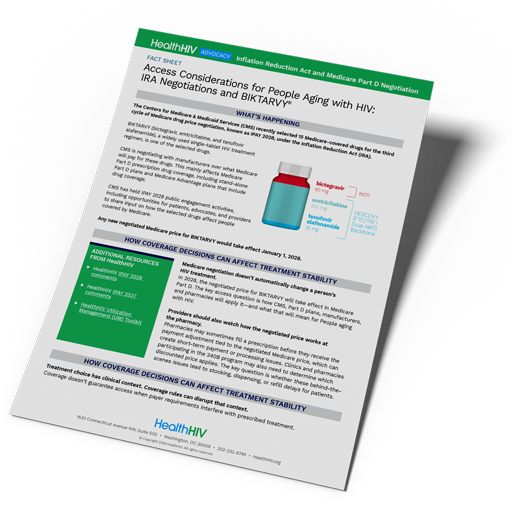
Access Considerations for People Aging with HIV: IRA Negotiations and BIKTARVY®
The Centers for Medicare and Medicaid Services recently selected 15 Medicare-covered drugs for the third cycle of Medicare drug price negotiation, known as IPAY 2028, under the Inflation Reduction Act.
BIKTARVY (bictegravir, emtricitabine, and tenofovir alafenamide), a widely used single-tablet HIV treatment regimen, is one of the selected drugs.
This fact sheet provides information and considerations on these negotiations.
Learn MoreRelated Health Policy Resources
Browse All Resources-
National Health Council IPAY 2028 Patient and Provider Toolkit
Overview of IPAY 2028, including an op-ed, written comments, and a communications toolkit.
-
Letter to the Centers for Medicare and Medicaid Services
Letter by HealthHIV, September 18, 2026.
-
Access Considerations for People Aging with HIV: IRA Negotiations and BIKTARVY®
The Centers for Medicare & Medicaid Services (CMS) recently selected 15 Medicare-covered drugs for the third cycle of Medicare drug price negotiation, known as IPAY 2028, under the Inflation Reduction Act (IRA). BIKTARVY (bictegravir, emtricitabine, and tenofovir alafenamide), a widely used single-tablet HIV treatment regimen, is one of the selected drugs. This fact sheet provides information and considerations on these negotiations.
-
Joint Statement and Public Comments on the Proposed Changes to Connecticut’s Medicaid Protected Drug Classes
ADAP Advocacy and HealthHIV issued the following joint statement in response to the proposed changes to services for People Living with HIV/AIDS (PLWHA) under Medicaid as set forth in the Connecticut Governor’s Health and Human Services budget recommendations.
Additional Resources
Drug Affordability in Practice: Who Saves, Who Pays, and What Happens to Access?
Join HealthHIV and its partners—AiArthritis, the Partnership to Improve Patient Care (PIPC), the Partnership for Safe Medicines, and the Rare Access Action Project (RAAP)—for a webinar that will examine where savings are anticipated to occur, who likely benefits, and how payment decisions can impact: coverage, reimbursement, benefit design, provider and pharmacy practices, patient assistance programs, and out-of-pocket costs.
When Cost-Cutting Undermines HIV Care—The Case for Single-Tablet Regimens
Op-Ed in PositivelyAware, April 21, 2026
Unmet Medical Need Comments
Comments by HealthHIV, July 3, 2025.
Medicare Drug Price Negotiation Program Draft Guidance Comments (IPAY 2027)
Comments by HealthHIV, July 2, 2024.
Medicare Drug Price Negotiation Program Draft Guidance Comments (IPAY 2028)
Comments by HealthHIV, April 8, 2026.


